Skip to content

Hearing plays a big role in how children learn, communicate, and explore the world. Many families are surprised to learn just how common hearing differences are—and how much support is available. If you child has just been diagnosed as have a hearing impairment, no matter whether it is sensory neural (permanent) or conductive (temporary) or the level of hearing impairment, support is out there for them.  

How Common Is Hearing Loss?

  • Over 50,000 children in the UK have some level of permanent hearing loss.
  • At birth, around 1–2 in every 1,000 babies are born with permanent hearing loss.
  • During childhood, some children develop hearing loss later on—often due to infections such as meningitis or, in rare cases, medication side effects.
  • Hearing loss can also be progressive or very mild at first, meaning some children are only identified as they get older.

How Hearing Loss Can Affect Children

Hearing plays a big role in learning and social development. Without support, hearing loss can influence:

  • Communication and speech
  • Language and literacy skills
  • Social confidence and friendships
  • Concentration and progress at school

With timely help—whether through hearing aids, cochlear implants, educational support, or communication strategies—children can develop confidently and successfully.

If you give birth in hospital, you may be offered a new born hearing test for your baby before you're discharged.

Otherwise it will be done by a healthcare professional, healthcare assistant or health visitor within the first few weeks.

You'll be contacted by your local newborn hearing screening service to arrange a suitable time and venue.

Ideally, the test is done in the first 4 to 5 weeks, but it can be done at up to 3 months of age.

If you're not offered a screening test, ask your health visitor, local audiology department or GP to arrange an appointment, or contact your local new born hearing screening service.

This is how most hearing impaired children are diagnosed. If you are concerned about your child's hearing after they have had the New born Hearing Screening Test, make an appointment with their GP as they can refer your child to an audiologist to have their hearing checked. 

If you give birth in hospital, you may be offered a new born hearing test for your baby before you're discharged.

Otherwise it will be done by a healthcare professional, healthcare assistant or health visitor within the first few weeks.

You'll be contacted by your local newborn hearing screening service to arrange a suitable time and venue.

Ideally, the test is done in the first 4 to 5 weeks, but it can be done at up to 3 months of age.

If you're not offered a screening test, ask your health visitor, local audiology department or GP to arrange an appointment, or contact your local new born hearing screening service.

This is how most hearing impaired children are diagnosed. If you are concerned about your child's hearing after they have had the New born Hearing Screening Test, make an appointment with their GP as they can refer your child to an audiologist to have their hearing checked. 

There is a wide range of aids and equipment that can make everyday activities and tasks easier.

What is a hearing aid?

Hearing aids are electronic devices that make sounds clearer. They can be used by children and young people of all ages. They are customised for each child's type and level of deafness, including temporary hearing loss such as glue ear.

More information

What is a cochlear implant?

A cochlear implant is a device which can improve access to sound for some people who do not get useful benefit from conventional acoustic hearing aids. Cochlear implants are appropriate for both adults and children with severe to profound hearing impairment in both ears.

A cochlear implant is an electronic device which is made up of two components: the internal component is inserted into the inner ear (cochlea) during an operation; the external component is called a speech processor and is worn on the head or body, like a hearing aid.

More information

It is up to you if you decide you would like your child to have cochlear implants. It does involve a serious operation which is a scary thing for a parent to contemplate but it can allow your child to develop speech more easily. If you are a Deaf parent yourself, you may want your child to be part of the Deaf community and that is totally fine. It is a decision that all parents have to make for themselves. 

Other types of assistive technology

The Royal National Institute for Deaf People (RNID) has information about assistive devices and technology which can give you more information on what other assistive technologies exist.

Your child's audiologist will explain all the different options to you and most equipment is funded by the NHS. At school your child may have a Teacher of the Deaf who can help the school support them. They can also provide the school with any equipment that they may need, such as a radio aid, to help your child hear in the classroom.
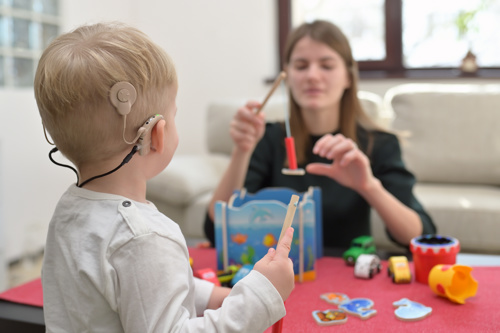
There is a wide range of aids and equipment that can make everyday activities and tasks easier.

What is a hearing aid?

Hearing aids are electronic devices that make sounds clearer. They can be used by children and young people of all ages. They are customised for each child's type and level of deafness, including temporary hearing loss such as glue ear.

More information

What is a cochlear implant?

A cochlear implant is a device which can improve access to sound for some people who do not get useful benefit from conventional acoustic hearing aids. Cochlear implants are appropriate for both adults and children with severe to profound hearing impairment in both ears.

A cochlear implant is an electronic device which is made up of two components: the internal component is inserted into the inner ear (cochlea) during an operation; the external component is called a speech processor and is worn on the head or body, like a hearing aid.

More information

It is up to you if you decide you would like your child to have cochlear implants. It does involve a serious operation which is a scary thing for a parent to contemplate but it can allow your child to develop speech more easily. If you are a Deaf parent yourself, you may want your child to be part of the Deaf community and that is totally fine. It is a decision that all parents have to make for themselves. 

Other types of assistive technology

The Royal National Institute for Deaf People (RNID) has information about assistive devices and technology which can give you more information on what other assistive technologies exist.

Your child's audiologist will explain all the different options to you and most equipment is funded by the NHS. At school your child may have a Teacher of the Deaf who can help the school support them. They can also provide the school with any equipment that they may need, such as a radio aid, to help your child hear in the classroom.

A Teacher of the Deaf (ToD) is a specialist educator with extra qualifications who supports children with hearing loss to develop language, communication, and learning skills, working with families, students, and other professionals in various settings from homes to schools, using methods like sign language, spoken language, or both, to ensure students can reach their full potential.


A Teacher of the Deaf (ToD) is a specialist educator with extra qualifications who supports children with hearing loss to develop language, communication, and learning skills, working with families, students, and other professionals in various settings from homes to schools, using methods like sign language, spoken language, or both, to ensure students can reach their full potential.


What is a community connector?

Community connectors are parents of deaf children, working in your area to drive change, offer support and build a strong local community of deaf children and their families. 

Our incredible team of connectors are all employed by the National Deaf Children’s Society. Their first hand experience of raising deaf children helps them bridge the gap between families, health professionals and education providers.

Every community is different and has different needs. Community connectors know their local area well and are best placed to offer tailored support that has a real impact on deaf children and families.

How can my local community connector help?

Your local community connector is a point of contact for all families of deaf children in your area. They are there to:

  • listen and offer emotional support
  • share their experiences
  • help families find and access local resources
  • lead campaigns for improving provision for deaf children at a local level
  • bring deaf children and their families together for fun, friendship and support

How do I contact the Community Connector for Hampshire?

Contact: Kayleigh Greenwood

Call or send a text message07974 363480

Email: kayleigh.greenwood@ndcs.org.uk

Book an online meeting

What is a community connector?

Community connectors are parents of deaf children, working in your area to drive change, offer support and build a strong local community of deaf children and their families. 

Our incredible team of connectors are all employed by the National Deaf Children’s Society. Their first hand experience of raising deaf children helps them bridge the gap between families, health professionals and education providers.

Every community is different and has different needs. Community connectors know their local area well and are best placed to offer tailored support that has a real impact on deaf children and families.

How can my local community connector help?

Your local community connector is a point of contact for all families of deaf children in your area. They are there to:

  • listen and offer emotional support
  • share their experiences
  • help families find and access local resources
  • lead campaigns for improving provision for deaf children at a local level
  • bring deaf children and their families together for fun, friendship and support

How do I contact the Community Connector for Hampshire?

Contact: Kayleigh Greenwood

Call or send a text message07974 363480

Email: kayleigh.greenwood@ndcs.org.uk

Book an online meeting

British Sign Language is a visual language that uses hand gestures, facial expressions, and body language to communicate. It is completely separate from the verbal English language and has different vocabulary and grammar. The first official record of BSL was at a wedding ceremony at St. Martin’s Church in Leicester, 1576.  The groom was deaf so the ceremony was conducted partially in British Sign Language. In 2016 the British Deaf Association stated that there are over 151,000 people who use BSL in the UK, this figure excludes professional BSL users. Each country has its own sign language and there are over 100 different sign languages in the world today.  Over time different regions in the UK adapted sign language so that it reflects local accents and verbal dialects. 

Your child's Teacher of the Deaf can help you learn some basics signs to get you started if you want to learn BSL.

If you would like to continue to learn BSL, these charities can help you:

Royal Association for Deaf People

British Deaf Association

National Deaf Children's Society

British Sign Language is a visual language that uses hand gestures, facial expressions, and body language to communicate. It is completely separate from the verbal English language and has different vocabulary and grammar. The first official record of BSL was at a wedding ceremony at St. Martin’s Church in Leicester, 1576.  The groom was deaf so the ceremony was conducted partially in British Sign Language. In 2016 the British Deaf Association stated that there are over 151,000 people who use BSL in the UK, this figure excludes professional BSL users. Each country has its own sign language and there are over 100 different sign languages in the world today.  Over time different regions in the UK adapted sign language so that it reflects local accents and verbal dialects. 

Your child's Teacher of the Deaf can help you learn some basics signs to get you started if you want to learn BSL.

If you would like to continue to learn BSL, these charities can help you:

Royal Association for Deaf People

British Deaf Association

National Deaf Children's Society

Deaf Action provides communication support. They have qualified interpreters, communicators, note-takers (both electronic and manual) and lip-speakers. They cover a wide range of bookings. This includes medical appointments, job interviews and conferences, weddings and funerals.

For people who are deaf, hard of hearing, speech impaired or deafblind, Hampshire & Isle of Wight Constabulary has some alternative ways to contact them.

Police Link Officers are also available with sign language, lip-speaking and deafblind manual skills. They communicate with people to give information and advice and to provide a link to other police departments.

Deaf Action provides communication support. They have qualified interpreters, communicators, note-takers (both electronic and manual) and lip-speakers. They cover a wide range of bookings. This includes medical appointments, job interviews and conferences, weddings and funerals.

Hampshire County Council’s Deaf Services Team. are a specialist team of social workers and care managers with sign language skills.

National Deaf CAMHS is a mental health service for deaf children with a range of emotional, behavioural and developmental difficulties.  

The team supports children who experience mental health difficulties and are either: 

  • Severely or profoundly deaf 
  • Use British Sign Language (BSL) or Sign Supported English (SSE) as their preferred / first language 
  • Have a significant language impairment related to being moderately or profoundly deaf.

Deaf Action provides communication support. They have qualified interpreters, communicators, note-takers (both electronic and manual) and lip-speakers. They cover a wide range of bookings. This includes medical appointments, job interviews and conferences, weddings and funerals.

For people who are deaf, hard of hearing, speech impaired or deafblind, Hampshire & Isle of Wight Constabulary has some alternative ways to contact them.

Police Link Officers are also available with sign language, lip-speaking and deafblind manual skills. They communicate with people to give information and advice and to provide a link to other police departments.

Deaf Action provides communication support. They have qualified interpreters, communicators, note-takers (both electronic and manual) and lip-speakers. They cover a wide range of bookings. This includes medical appointments, job interviews and conferences, weddings and funerals.

Hampshire County Council’s Deaf Services Team. are a specialist team of social workers and care managers with sign language skills.

National Deaf CAMHS is a mental health service for deaf children with a range of emotional, behavioural and developmental difficulties.  

The team supports children who experience mental health difficulties and are either: 

  • Severely or profoundly deaf 
  • Use British Sign Language (BSL) or Sign Supported English (SSE) as their preferred / first language 
  • Have a significant language impairment related to being moderately or profoundly deaf.

Hearing Link provides information, advice and community support for people with hearing loss, their families and friends.

RNID provides support, advice and training for people with hearing loss and tinnitus. 

RAD (Royal Association for Deaf People) provides a wide range of services for deaf people. All services are delivered in British Sign Language (BSL).

Deafblind UK and Sense offer information and support for people who are deafblind and their families.

Deaf Action aims to enable deaf, deafened, deaf-blind and hard-of-hearing people to maintain their independence. Amongst other services, they provide community support across Hampshire.

DeafPlus offers an online information and advice hub (information in BSL and text).

A sunflower lanyard was introduced at major UK airports in 2018 in order to allow passengers with hidden disabilities to indicate discreetly to staff that they may need additional support or help. The use of the lanyard has now spread and is now available from a number of transport providers. You can pick up a free lanyard at Tesco.

Hampshire County CouncilSouthampton City Council and Portsmouth City Council have teams to help residents with sensory loss. They can carry out assessments and provide training to help you find practical solutions to the everyday problems that arise from hearing loss.

Hearing Link provides information, advice and community support for people with hearing loss, their families and friends.

RNID provides support, advice and training for people with hearing loss and tinnitus. 

RAD (Royal Association for Deaf People) provides a wide range of services for deaf people. All services are delivered in British Sign Language (BSL).

Deafblind UK and Sense offer information and support for people who are deafblind and their families.

Deaf Action aims to enable deaf, deafened, deaf-blind and hard-of-hearing people to maintain their independence. Amongst other services, they provide community support across Hampshire.

DeafPlus offers an online information and advice hub (information in BSL and text).

A sunflower lanyard was introduced at major UK airports in 2018 in order to allow passengers with hidden disabilities to indicate discreetly to staff that they may need additional support or help. The use of the lanyard has now spread and is now available from a number of transport providers. You can pick up a free lanyard at Tesco.

Hampshire County CouncilSouthampton City Council and Portsmouth City Council have teams to help residents with sensory loss. They can carry out assessments and provide training to help you find practical solutions to the everyday problems that arise from hearing loss.