Parents and carers of children, young people and adults can access financial support to help them. Our advice also includes balancing working with caring responsibilities.
Directory of Support Services
I am not sure what is meant to be in this section.
Parents and carers of children, young people and adults can access financial support to help them. Our advice also includes balancing working with caring responsibilities.
We have created a guide for parents caring for a child, young person or adult with additional needs.
This covers:
- Building Support Networks for Carers
- Listening Ear Services
- Help to have a holiday
- Nimbus Access and Gateway Cards
- Support and Guidance
- Advice from Local and National Charities
We have created a guide for parents caring for a child, young person or adult with additional needs.
This covers:
- Building Support Networks for Carers
- Listening Ear Services
- Help to have a holiday
- Nimbus Access and Gateway Cards
- Support and Guidance
- Advice from Local and National Charities
Our guide here covers how to support your other children when you have a child, young person or adult with additional support needs.
Our guide here covers how to support your other children when you have a child, young person or adult with additional support needs.
If your child or young person's attendance is being impacted on by their neurodiversity, read our guide to supporting children and young people to access education.
If your child or young person's attendance is being impacted on by their neurodiversity, read our guide to supporting children and young people to access education.
The i‑THRIVE Approach in Hampshire and the Isle of Wight
Across Hampshire and the Isle of Wight, services follow the i‑THRIVE approach — a national framework that helps children and young people get the right mental health and wellbeing support at the right time.
The THRIVE Framework was developed by experts at the Anna Freud Centre and the Tavistock & Portman NHS Foundation Trust. It moves away from waiting for a diagnosis and instead focuses on your child’s needs, shared decision‑making, and joined‑up working between families, schools, health teams, and other services.
We know that trying to find the right support for your child can feel overwhelming. The i‑THRIVE approach is designed to make this clearer and simpler. It helps everyone involved use the same language, understand the same process, and work together in a way that feels consistent and supportive — so your child receives the help they need when they need it.
By being needs‑led, i‑THRIVE ensures that support is shaped around what will help your child right now, rather than strict criteria or diagnostic labels. It’s used across England and is at the heart of how we’re improving support for children and young people locally.
Below is a parent‑friendly overview of how it works.
Using the THRIVE Model, we can offer support for Neurodiversity & Wellbeing needs in the following ways :
-
Using a needs‑led, strengths‑based way of supporting children, young people and families.
-
A Thrive approach fits well with neurodiversity‑affirming approaches, which highlight strengths, inclusion, and understanding of individual differences
-
Thrive approach is offered in different stages , click on the icon below to read about each one .
Using the THRIVE Model, we can offer support for Neurodiversity & Wellbeing needs in the following ways :
-
Using a needs‑led, strengths‑based way of supporting children, young people and families.
-
A Thrive approach fits well with neurodiversity‑affirming approaches, which highlight strengths, inclusion, and understanding of individual differences
-
Thrive approach is offered in different stages , click on the icon below to read about each one .
A needs based approach...
A needs based approach...
i‑THRIVE focuses on:
- Clear, consistent information so families understand their options.
- Joined‑up working between health, education, social care, and other services.
- Shared decision-making, where you and your child help shape the support plan.
- Support at all levels, from general advice to specialised help.
- Meeting needs early, rather than waiting for things to get worse.
For parents, this means fewer barriers and a clearer pathway to support.
i‑THRIVE focuses on:
- Clear, consistent information so families understand their options.
- Joined‑up working between health, education, social care, and other services.
- Shared decision-making, where you and your child help shape the support plan.
- Support at all levels, from general advice to specialised help.
- Meeting needs early, rather than waiting for things to get worse.
For parents, this means fewer barriers and a clearer pathway to support.
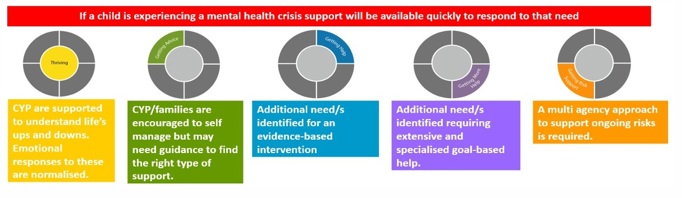
Instead of using a diagnosis or severity to decide support, i‑THRIVE organises help into five categories. This makes it easier to see what type of support is right for your child.
1. Thriving
Your child is doing well, with no additional support needed right now beyond universal services like school, GP, or community activities.
2. Getting Advice & Signposting
You’re looking for guidance, reassurance, or help understanding your child’s needs. This might include advice from school, online resources, community services, or brief professional input.
3. Getting Help
Your child would benefit from targeted support, such as counselling, behaviour strategies, or structured interventions delivered by trained professionals.
4. Getting More Help
Your child has more complex or long‑term needs and requires specialist support or therapies from mental health teams or multi‑disciplinary professionals.
5. Getting Risk Support
Used when a child is struggling in ways that may pose a risk to themselves or others, and when traditional therapy may not be enough. The focus is on managing safety and coordinating support across agencies.
Instead of using a diagnosis or severity to decide support, i‑THRIVE organises help into five categories. This makes it easier to see what type of support is right for your child.
1. Thriving
Your child is doing well, with no additional support needed right now beyond universal services like school, GP, or community activities.
2. Getting Advice & Signposting
You’re looking for guidance, reassurance, or help understanding your child’s needs. This might include advice from school, online resources, community services, or brief professional input.
3. Getting Help
Your child would benefit from targeted support, such as counselling, behaviour strategies, or structured interventions delivered by trained professionals.
4. Getting More Help
Your child has more complex or long‑term needs and requires specialist support or therapies from mental health teams or multi‑disciplinary professionals.
5. Getting Risk Support
Used when a child is struggling in ways that may pose a risk to themselves or others, and when traditional therapy may not be enough. The focus is on managing safety and coordinating support across agencies.
For neurodivergent children or those with additional needs, i‑THRIVE can be especially supportive because:
- You don’t have to wait for a diagnosis to receive help.
- It recognises that needs change over time — support can increase or decrease as needed.
- School, health, and social care work together rather than separately.
- It values your expertise as a parent and your child’s voice.
The framework is designed for all children aged 0–25, including those at risk of or experiencing mental health or wellbeing challenges.
For neurodivergent children or those with additional needs, i‑THRIVE can be especially supportive because:
- You don’t have to wait for a diagnosis to receive help.
- It recognises that needs change over time — support can increase or decrease as needed.
- School, health, and social care work together rather than separately.
- It values your expertise as a parent and your child’s voice.
The framework is designed for all children aged 0–25, including those at risk of or experiencing mental health or wellbeing challenges.
With i‑THRIVE, you can expect:
- A clearer understanding of what support is available
- Professionals who use the same language when describing needs
- Support tailored to your child, not a one‑size‑fits‑all approach
- Opportunities to be involved in every decision
- Early help rather than waiting for difficulties to escalate
With i‑THRIVE, you can expect:
- A clearer understanding of what support is available
- Professionals who use the same language when describing needs
- Support tailored to your child, not a one‑size‑fits‑all approach
- Opportunities to be involved in every decision
- Early help rather than waiting for difficulties to escalate