Complaints and compliments
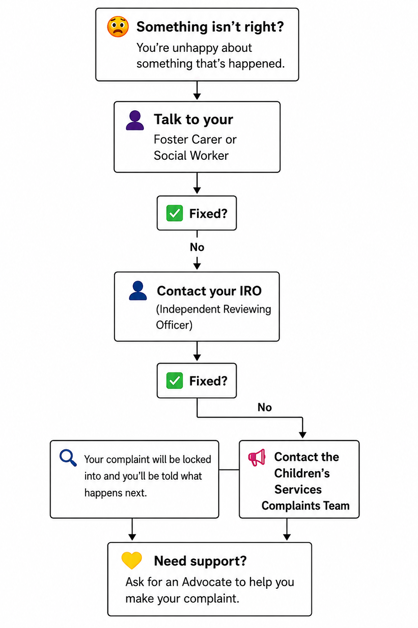
Sometimes in care, things don't always go as planned and you may feel that you want to complain about something that may have happened that you’re not happy about.
In the first instance try speaking to your foster carer or social worker about anything you are not happy with.
If you’re not happy speaking to either your foster carer or social worker then you should contact your Independent Reviewing Officer (IRO) who will be able to support you in addressing any issues that you may have around the reason your unhappy.
If you feel that your complaint or issue hasn't been dealt with, you feel you are being ignored, or you’re unsure of who you can speak to, Hampshire County Council has an independent complaints team who will take up your complaint and/or feedback and ensure it is investigated further. They will let you know after they have finished investigating and explain their findings to you.
You don't have to feel alone in this process, Hampshire County Council can provide you with someone who will help you to make your complaint, they are known as an advocate. They could be someone such as a foster carer, a teacher or a member of your family and they will be allowed to speak on your behalf.
You can also make a complaint anonymously if you wish, however this means it is unlikely the response can then be shared with you.
Making a complaint or raising an issue will not impact on the quality of care and support you get from those around you, however if you have concerns you should approach the Children’s Services Complaints Team.
Your complaint has the potential to change the service for other children and young people and listening to feedback is one of the many ways Hampshire County Council’s Children’s Services can keep getting better.
Don’t wait too long:
- Complain as soon as you can. It’s easier to remember what happened and it makes it easier for us to investigate.
- Remember, you can only complain about things that happened in the last year.
Say it’s a complaint:
- At the top of your letter or email, write: “This is a complaint.”
- Get proof it was received (like a receipt or email reply).
- Write down the date and time you sent it.
Keep it short and clear:
- Tell the important points only.
- Put things in order (by time or topic).
- Don’t talk about old stuff—only what happened in the last year.
- Don’t use lots of colours, big letters, or too many exclamation marks.
Sending proof:
- Proof means something that shows you’re telling the truth.
- Normally we will already be able to see what has happened on our own records so don't worry too much about sending proof but if you have emails or documents that you don't think we have already, you can send these to us.
- Send copies, not originals. Keep your own copies safe.
What to write in your complaint:
- Say what went wrong.
- Explain how this has affected you.
- Suggest what we can do to fix it (like an apology or doing something we promised).
- Be polite—even if you’re upset.
To make a complaint please complete the Children's Services complaints form. If you need help completing the complaints form, an adult can help you such as foster carer, social worker, personal advisor, staff at your care home or IRO. If you need us to, we will appoint an advocate to help you. We want to hear from you and for you to have a voice. Any help you need to be able to speak to us, we can help with.
Don’t wait too long:
- Complain as soon as you can. It’s easier to remember what happened and it makes it easier for us to investigate.
- Remember, you can only complain about things that happened in the last year.
Say it’s a complaint:
- At the top of your letter or email, write: “This is a complaint.”
- Get proof it was received (like a receipt or email reply).
- Write down the date and time you sent it.
Keep it short and clear:
- Tell the important points only.
- Put things in order (by time or topic).
- Don’t talk about old stuff—only what happened in the last year.
- Don’t use lots of colours, big letters, or too many exclamation marks.
Sending proof:
- Proof means something that shows you’re telling the truth.
- Normally we will already be able to see what has happened on our own records so don't worry too much about sending proof but if you have emails or documents that you don't think we have already, you can send these to us.
- Send copies, not originals. Keep your own copies safe.
What to write in your complaint:
- Say what went wrong.
- Explain how this has affected you.
- Suggest what we can do to fix it (like an apology or doing something we promised).
- Be polite—even if you’re upset.
To make a complaint please complete the Children's Services complaints form. If you need help completing the complaints form, an adult can help you such as foster carer, social worker, personal advisor, staff at your care home or IRO. If you need us to, we will appoint an advocate to help you. We want to hear from you and for you to have a voice. Any help you need to be able to speak to us, we can help with.
You can get in touch with the complaints team via:
- 📝 Online: Compliments, Complaints and Data Protection form
- 📧 Email: childrens.services.complaints@hants.gov.uk
- 📞 Phone: 0300 555 1384
- 📮 Post: Freepost HAMPSHIRE
(Writing CSD Complaints FM42 on the back of the envelope will get it to us quicker)
Children's Services Complaints Team
Hampshire County Council,
EII Court South,
Winchester,
Hampshire
SO23 8UJ
Remember
✅ Making a complaint will not affect the care and support you receive.
✅ You do not have to go through the process on your own.
✅ Your feedback could help improve services for other children and young people.
You can get in touch with the complaints team via:
- 📝 Online: Compliments, Complaints and Data Protection form
- 📧 Email: childrens.services.complaints@hants.gov.uk
- 📞 Phone: 0300 555 1384
- 📮 Post: Freepost HAMPSHIRE
(Writing CSD Complaints FM42 on the back of the envelope will get it to us quicker)
Children's Services Complaints Team
Hampshire County Council,
EII Court South,
Winchester,
Hampshire
SO23 8UJ
Remember
✅ Making a complaint will not affect the care and support you receive.
✅ You do not have to go through the process on your own.
✅ Your feedback could help improve services for other children and young people.
Your views help us to improve services. It is helpful to know when you think we did something well, and if anything in particular impressed you.
You can get in touch with compliments here:
- Email: childrens.services.complaints@hants.gov.uk
- Phone: 0300 555 1384
Your views help us to improve services. It is helpful to know when you think we did something well, and if anything in particular impressed you.
You can get in touch with compliments here:
- Email: childrens.services.complaints@hants.gov.uk
- Phone: 0300 555 1384