Communication
Why communication matters
This video offers a helpful insight into why good communication is important for people with additional needs.
Aids to support communication needs
There is a range of aids which can support your child’s communication needs, whether caused by a sensory impairment, a physical disability or global developmental delay.
Augmentative and Alternative Communication (AAC) refers to tools, strategies, and techniques used to support or replace spoken language for individuals with communication difficulties. It includes low-tech methods like pictures and gestures, as well as high-tech speech-generating devices, helping people with conditions like autism or cerebral palsy express themselves independently.
Who Uses AAC?
AAC is for anyone who has trouble with producing or understanding spoken or written language, including children and adults with cerebral palsy, autism, intellectual disabilities, stroke, or motor neuron diseases. It can be a temporary tool while speech develops or a lifelong communication method.
Key Aspects of AAC:
- Augmentative: Supplements existing speech to make it clearer.
- Alternative: Used in place of speech when an individual is non-speaking or not easily understood.
Types:
-
- Unaided: Uses only the body, such as gestures, facial expressions, and sign language.
- Aided: Uses tools ranging from paper-based picture boards (low-tech) to specialised computer apps and eye-gaze technology (high-tech).
Benefits of AAC:
- Independence: Allows individuals to communicate their own thoughts and needs.
- Reduced Frustration: Provides a functional way to interact when speech is not possible.
- Improved Social Interaction: Enables participation in daily activities and education.
AAC systems are often personalised to the user's specific vocabulary, needs, and physical abilities, frequently implemented with the help of a Speech and Language Therapist.
Communication Matters website provides information to support people in accessing AAC Assessments Services to find the right AAC System that for them.
Communication Passports
Many children and young people are unable to communicate their needs and it can be very time consuming for parents/carers to constantly repeat the same information to activity providers. This is where a communication passport can be very helpful.
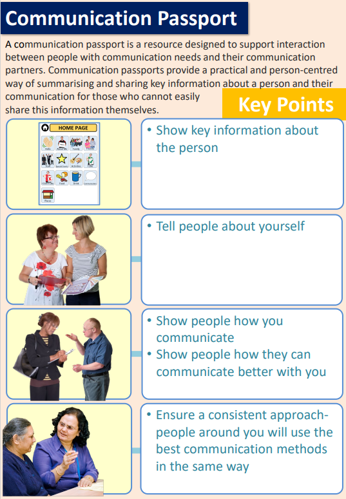
A passport aims to present each individual in a positive way rather than as a set of difficulties, it allows space for the child/young person to express their own likes or dislikes and views; it also should reflect their character and sense of humour; it will describe the most effective communication method and how others should communicate with them; finally it should be easy to read, informative and fun.
There are some communication passport templates that you can use and you can find our more information, including how to create a passport on the Communications Passport website.
See the video below for more information about communication passports.
My Health Passport
If your child or young person struggles with communication it is a good idea to sit down with them and create a My Health Passport. This is a special communication passport for health care settings like hospitals. It helps the doctors, nurses and Healthcare Practitioners understand your child or young person's needs.
When you have completed the passport, take it with you whenever you visit hospital with your child or young person and show it to the doctors, nurses and any other healthcare professionals they come into contact with.
If your child or young person is admitted to hospital for treatment overnight or for a long stay, you should:
- give the passport to the doctor or nurse responsible for their care
- ask them to make sure the passport is kept with the patient notes at the end of the bed.
Template My Health Passport and guidance on how to complete it